LatestRounds
LatestRounds is a free, daily feed of startup funding: who raised, how much, who led the round, and which of those companies started hiring within two weeks of the money landing.
I’m the only person on it. There’s no newsroom typing rounds in, so the interesting part is everything behind the table: how an announcement on some blog becomes a clean row with a logo, an investor and a city, six times a day, without me touching it. This is how that works, and what I changed in November 2026 when the old setup kept running out of room.
The daily feed
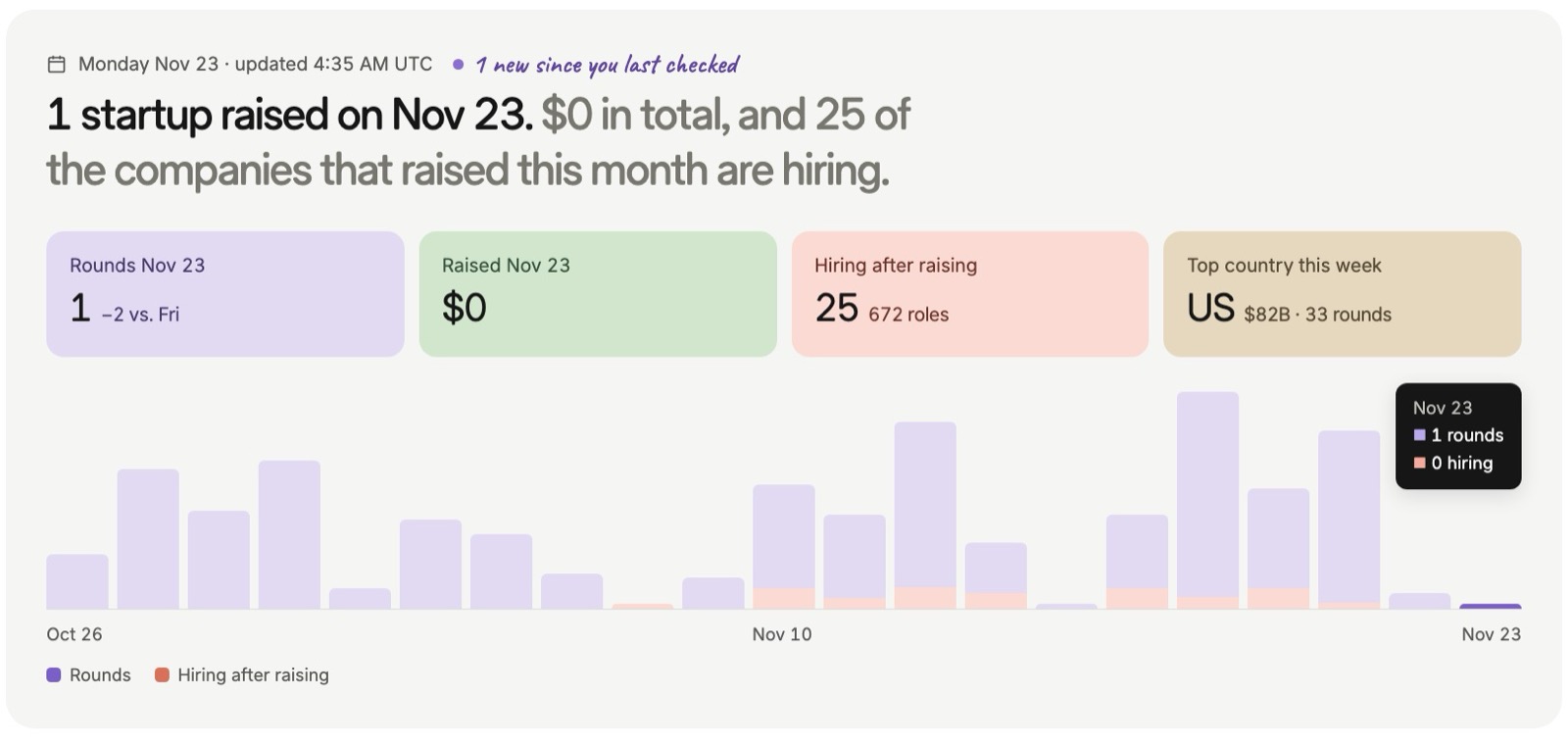
The home page answers one question first: what happened today? A sentence sums up the day, then four numbers, then a 30-day chart where the companies already hiring are stacked under each bar. Below that is the table of rounds, filterable by stage, sector, country and “hiring only”.
Anything that arrived since your last visit sits above a handwritten line, so you can see what’s new without reading every row.
- BBoba BhaiFood and BeverageSeries B$18MBengaluru
- VVetaionIndustrial AutomationPre-Seed$6.3MMunich
- IIntelliProveDigital HealthSeed$3MHiring
- MMetaCompFintechVenture$10MSingapore
- HHopliteDeveloper ToolsVenture$5.5MSan Francisco
A round tells you a company has money. Open roles tell you it’s spending it. A company counts as hiring when it posts new roles within 14 days of raising, and those companies get their own column, a filter and a strip of job cards under the table.
Where the rounds come from
Every round starts as an announcement in one of 56 news and press feeds. The first live run pulled 101 unique announcements, with 10 feeds failing that time (blocked, timed out or broken XML). A failed feed is reported and the rest carry on.
From there it’s a queue, and each step does one thing. Collection runs six times a day. Ten minutes after each run, a scheduled ChatGPT task connects to a small private MCP server I wrote, claims a batch, and researches every announcement from primary sources: the company’s own site, the press release, the lead investor. It submits structured JSON back through the same server.
A systemd timer on the server reads 56 feeds and keeps the announcements that look like funding news. A second filter drops the rest.
status: queued
source: press feed
company: ?
The rule that matters most is in the check step: never make anything up. A missing website stays missing and shows up as a gap to fix, rather than a confident guess that quietly ends up on the page.
| Step | Runs | Notes |
|---|---|---|
| Collect | 09:00, 11:00, 14:00, 16:00, 18:00, 21:00 | Times are Manila, timed so alerts can go out at 10:00, 15:00 and 19:00 |
| Research | 10 minutes after each collection | Every run finishes the whole queue |
| Enrich | After each import | Logo.dev first, then the site's own icon if that 404s |
| Employee counts | Daily, 20:10 | Read from the LinkedIn page the company's own site links to |
| Refresh views | Every 30 minutes | The site never aggregates history on a request |
Running out of D1
The first version kept everything in Cloudflare D1 and the site queried it directly. That was fine until the account dropped to the Workers Free plan, where every database on the account shares 5 million rows read a day. LatestRounds alone was reading about 10.6 million.
| Query | Rows read / day | Calls |
|---|---|---|
| City rollups, aggregated on every call | 3.59M | 812 |
| Similar companies | 2.16M | 399 |
| Funding list COUNT(*) | 1.97M | 374 |
| Funding list pages | 1.69M | 377 |
| Country rollups | 0.66M | 276 |
When the limit hits, every D1 database on the account fails until midnight UTC, so a busy afternoon on one site could take down the others. I moved the data to Postgres on the small VPS that already ran my other projects’ collectors. Postgres has no daily read cap, and the server had room: 2 vCPU, about 4 GB of memory, and a load of zero.
One local hop
The plan was for the site to read through an API Worker connected to Postgres with Hyperdrive. On the day it went live, the account hit its free daily Hyperdrive limit at 12:30 UTC, and every request through it returned an error until midnight. The new endpoints were failing minutes after they were deployed.
The fix was to stop going the long way round. The site is Astro running on Node, on the same server as the database, so it now reads Postgres directly over a local connection. Cloudflare stays in front for DNS, TLS, the HTML cache and rate limiting, and reaches the server through a tunnel.
- Browserprefetch on hover
- CloudflareHTML cached 30 minmost stop here
- Tunnelno Worker requests
- Astro on Noderenders in 10–100 ms
- Postgresread-only login
The site’s database login can only read: SELECT grants, read-only transactions by default, a 15 second statement timeout. On top of that, the code refuses anything that isn’t a SELECT, so a bug in the site can’t write.
const READ_ONLY = /^\s*(select|with)\b/i; export async function all<T>(query: string, params: unknown[] = []) { if (!READ_ONLY.test(query)) throw new Error("Only SELECT queries are allowed"); // pool of 2: the login allows 4 connections in all return client().unsafe(query, params) as Promise<T[]>;}The heavy queries live in materialized views that the import service refreshes after each run. The site only reads those views plus small indexed lookups, which take 1 to 25 ms. With the HTML cached at the edge, the database sees a few hundred landing reads a day.
The trade-offs are written down next to the decision, so the next change doesn’t undo it by accident:
- The landing SQL now exists twice, here and in the API that other clients still use. A test seeds a throwaway Postgres and checks both return the same data.
- The site depends on view and column names instead of a versioned API, so schema changes have to update both repos together.
- Moving back to Workers later means swapping one file, the database module, for an HTTP client with the same functions.
Keeping it fast
On staging the home page felt sluggish: the globe turned slowly, hovers lagged and filter clicks flashed like page loads. I measured before changing anything.
| Globe setup | FPS | Main thread blocked |
|---|---|---|
| ~200 logos as DOM markers | 5 | 3.9 s of 4 s |
| Same, without shadows or transitions | 6 | 3.8 s of 4 s |
| Logos drawn by the map as a symbol layer | 120 | 0 |
The map library repositioned every DOM marker on every frame, so everything else on the page waited behind it. Drawing the logos on the GPU fixed it outright. The rest was smaller:
- Filters swap the table in place instead of loading a new page, but every filtered view is still a real, cacheable URL.
- Same-site links are prefetched on hover, so a click is served from the browser cache.
- The globe only spins while it’s on screen and the tab is visible.
- Each deploy purges Cloudflare, so the first visitors don’t get stale pages.
Built for search
People search for a company or an investor by name, so every company, investor, category, city, country and stage gets its own page. The old Next.js site rendered a lot of them in the browser. The Astro rebuild puts all the content in the HTML, and a set of rules keeps it that way.
| Rule | Why |
|---|---|
| One <head>, built in one place | Pages pass a title, description and path; nothing writes its own meta tags |
| One URL per page | Old URLs 308 to the canonical one; filtered views point their canonical at the clean URL |
| Content in the HTML | No public page waits on a client-side fetch for its main content |
| JSON-LD per page type | Organization for companies and investors, ItemList for lists, BreadcrumbList everywhere, Dataset for /data |
| noindex on thin pages | An empty list or a filter with no results shouldn't compete with real pages |
A test enforces it before every deploy. It fetches each kind of page the way Googlebot does and checks for exactly one title, one canonical, a non-empty heading, no stray noindex and valid JSON-LD. Titles and descriptions live in one file and keep the wording search engines already index.
Share images are drawn on the server for each page, from live data, with satori and resvg. A company’s link preview shows its current round, not whatever was true when someone first shared it.
There’s also an llms.txt and a sitemap built from the same queries as the pages, so a new company is listed as soon as its page exists.
An API, and an MCP for agents
The data also sits behind a separate API service with its own keys, ready for when paid access opens (the site lists it as coming soon). It’s metered in credits, so heavier calls cost more, and the same accounting covers MCP clients and plain HTTP.
| Endpoint | Credits |
|---|---|
GET /v1/funding/latest | 1 per record |
GET /v1/company | 4 |
GET /v1/company/:id/investors | 2 |
GET /v1/company/:id/jobs | 1 |
GET /v1/investor/:id/portfolio | 2 |
| A webhook event fired | 1 |
Keys are stored only as SHA-256 hashes. Internal services and customers get different key types, so the two are never mixed up. The MCP tools, like get_latest_funding and get_company_profile, are thin names over the same endpoints.
The public part is narrower on purpose: a jobs MCP that helps one person find a startup job. It has three tools and no sign-in.
"tools": [ "find_jobs", // role, remote or on-site, places, level → up to 10 roles "match_resume", // resume text → profile + roles that match N of M skills "subscribe_job_alerts" // email + answers → double opt-in sign-up]It reuses the jobs page’s own matching, rules only with no model, so it costs nothing to run. Results are capped at 10, calls are rate limited per IP, and resume text is never stored or logged. It’s not a way to pull funding data in bulk.
Decisions and trade-offs
Every project has a DECISIONS.md, newest first. Each entry says what was decided, who decided it, why, and what was rejected. To change one, I add a new entry instead of editing the old one, so the reasoning survives. These are the ones that shaped this rebuild.
| Choice | Instead of | Because |
|---|---|---|
| Astro, server-rendered | Next.js, vinext, SvelteKit, Hono | Plain HTML by default, the least JavaScript, 60–120 MB of memory, and an adapter back to Cloudflare if needed |
| Node on the VPS | Bun or Rust | Everything else on the server runs Node. Bun saved tens of MB with compatibility gaps; Rust meant a rewrite |
| Read Postgres directly | Through the API and Hyperdrive | One local hop, no shared daily limit, no Worker requests |
| No UI for unbuilt features | Coming-soon buttons and gates | Follow buttons, email gates and “check fit” came out until they work |
| Rounds in announcement order | Order they were added | Tried for a day and reverted: a Nov 10 round landed between Nov 16 rows |
Real data taught a few rules that stay:
- 5 to 30% of rounds don’t say how much. They show as “Undisclosed” in muted text, never as $0.
- Some companies post 90 roles in a week, so the hiring chart switches to stacked bars.
- Windows are rolling, so the copy says “in the last 30 days”, never “this month”.
- Postgres returns big counts as strings. Convert them once, in one place.
What's next
Funding alerts by email go out three times a day once Amazon SES approves production sending. Until then the sign-up form works in waitlist mode and sends nothing. Job alerts can match against a resume, but only a small profile is kept, never the file.
The site is free, and I’d like to keep it that way without accounts. The ideas on the list are all a payment link and a small form: a featured job post, a paid same-day review for startups submitting their own round, an embeddable “As seen on LatestRounds” badge, one-off CSV exports. Sponsored slots would always be labelled.
See today’s rounds on latestrounds.comBuilt with Astro, Node, Postgres, Cloudflare.